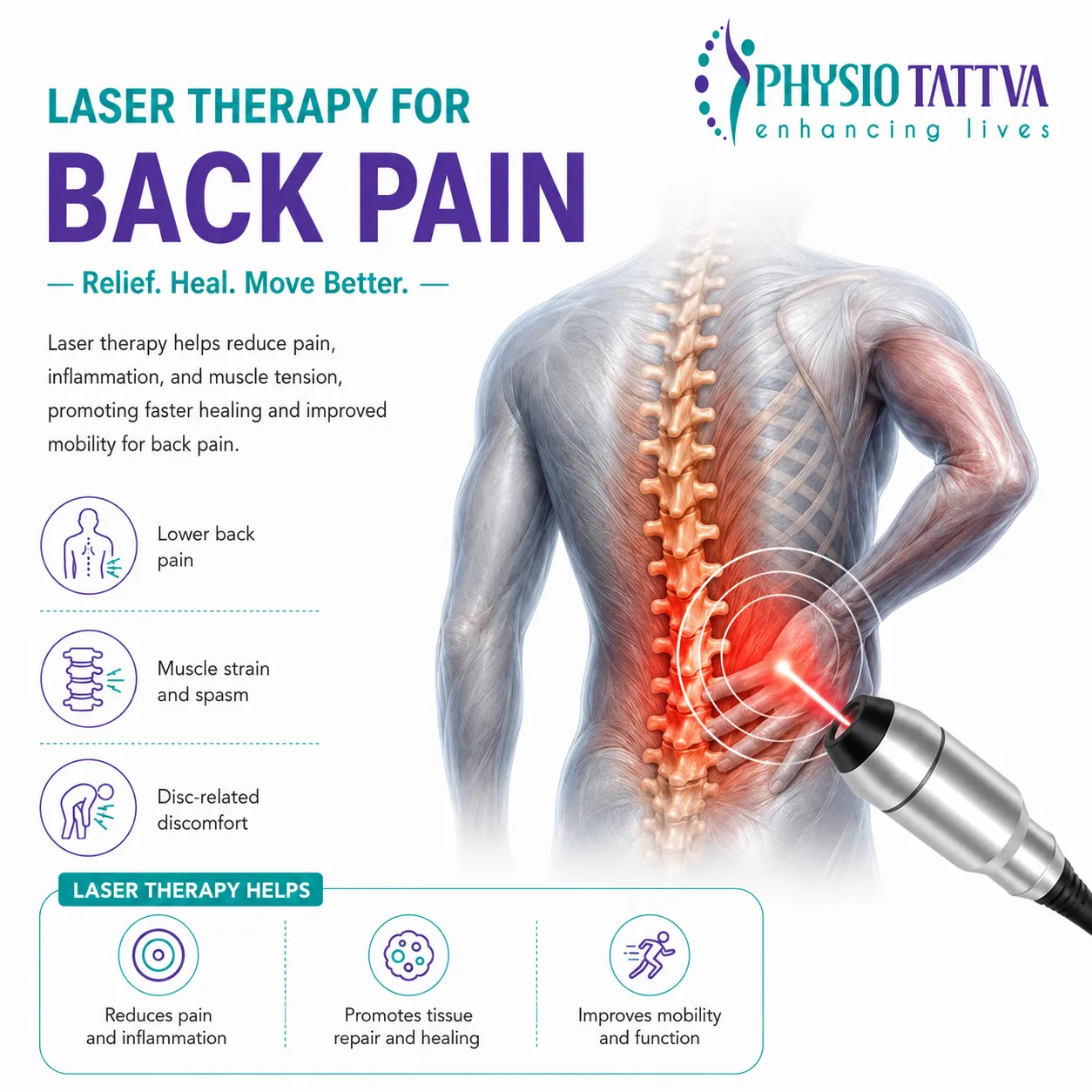
Laser therapy for back pain at Physiotattva offers a non-invasive and effective solution for pain relief. Using focused light to target deep tissues, it helps reduce inflammation, improves blood flow, and accelerates healing. Whether you're dealing with a herniated disc, muscle strain, or arthritis, laser therapy can help you recover faster with no downtime. Our expert therapists personalise your treatment, ensuring maximum comfort and results. Book your session today and start your journey to pain-free living.
Laser therapy for back pain is a non-invasive treatment that uses low-level light energy to reduce inflammation, support tissue recovery, and manage pain. It works by stimulating cellular activity and improving circulation in the affected tissues, which helps to alleviate discomfort in conditions like muscle strain, sciatica, herniated discs, and arthritis. The therapy is quick (10-20 minutes per session), painless, and can be easily integrated into a comprehensive rehabilitation plan. Most patients resume their normal activities immediately after treatment. It is safe, effective, and works best when combined with other physiotherapy treatments.
What Is Laser Therapy for Back Pain?
Laser therapy for back pain is a non-invasive physiotherapy treatment that uses low-level light energy to support pain relief and tissue recovery. The therapy works by delivering controlled light to affected areas, where it may help reduce inflammation and stimulate cellular repair processes.
This treatment does not involve medication or surgery. Instead, it is used as part of a structured rehabilitation plan to support recovery from musculoskeletal back conditions.
Types of Back Conditions Where Laser Therapy May Help
Laser therapy for back pain is commonly used in physiotherapy to support inflammation control and tissue recovery across various musculoskeletal conditions. The suitability of treatment depends on diagnosis, severity, and overall rehabilitation planning.
Laser therapy may be considered in the following conditions:
Acute muscle strain or soft tissue injury: Low-level light therapy may help modulate inflammation in recently strained muscles and support early tissue repair, particularly when swelling and movement restriction are present.
Sciatica and nerve irritation: When back pain is associated with nerve compression or irritation, laser therapy may assist in reducing surrounding inflammation and improving circulation around affected tissues.
Herniated or bulging discs: Laser treatment for back pain may help manage secondary inflammation around disc-related irritation, especially when nerve sensitivity contributes to radiating discomfort.
Arthritis-related back pain: In degenerative joint conditions, laser therapy may support circulation and help manage chronic inflammatory responses that contribute to stiffness and mobility limitation.
Post-surgical back recovery: Following spinal or soft tissue procedures, laser therapy may be integrated into rehabilitation programs to support tissue healing and manage inflammatory discomfort under clinical supervision.
Laser therapy for pain management is typically used as part of a structured physiotherapy plan rather than as a standalone intervention for structural spinal disorders.
How Does Laser Therapy for Back Pain Work?
Laser therapy for back pain works through a biological process known as photobiomodulation. During treatment, a device emits low-level light at specific wavelengths that pass through the skin and reach underlying soft tissues.
At the cellular level, this light energy is absorbed by mitochondria, which are responsible for producing cellular energy. The absorption may increase the production of adenosine triphosphate, or ATP. ATP plays a central role in tissue repair, regeneration, and cellular function.
As cellular energy levels improve, several physiological responses may occur:
Modulation of inflammatory mediators in irritated tissues
Improved microcirculation and oxygen supply to affected areas
Stimulation of cellular repair and metabolic activity
Reduced sensitivity of local pain receptors
By influencing these biological processes, laser treatment for back pain supports the body’s natural healing mechanisms. It is typically integrated into structured physiotherapy programs where inflammation control, mobility restoration, and tissue recovery are treatment priorities.
Types of Laser Therapies for Back Pain
Laser therapy for back pain can vary based on the wavelength, intensity, and depth of tissue penetration. Different types are selected depending on whether the target is superficial muscle tissue or deeper structures such as joints or discs.
The most commonly used types include:
Low-Level Laser Therapy (LLLT): Also known as cold laser therapy, this approach uses low-intensity light to stimulate cellular activity without generating heat. It is typically used for soft tissue inflammation, muscle strain, and mild to moderate back pain conditions.
High-Intensity Laser Therapy (HILT): This therapy delivers higher power light energy that penetrates deeper tissues. It is sometimes used in chronic or more complex musculoskeletal conditions where deeper inflammatory processes are involved.
Class III Laser Therapy: Class III lasers are low-power therapeutic lasers commonly used in physiotherapy settings. They are designed to stimulate tissue repair and reduce inflammation without thermal damage.
Class IV Laser Therapy: Class IV lasers operate at higher power levels and allow deeper tissue penetration. These may be used under strict clinical supervision in structured rehabilitation programs.
The choice of laser type depends on the diagnosis, tissue depth, and individual response to treatment. A trained physiotherapist determines the appropriate settings and protocol during evaluation.
What Are the Benefits of Laser Therapy for Back Pain?
Laser therapy for back pain is commonly integrated into physiotherapy programs where inflammation control and tissue recovery are priorities. While outcomes vary depending on diagnosis and severity, several clinical advantages are associated with its use in musculoskeletal rehabilitation.
Key potential benefits include:
Non-invasive approach: Laser therapy does not involve injections, incisions, or medication. Treatment is applied externally using a handheld device that delivers controlled light energy to targeted tissues.
Support for inflammation control: Photobiomodulation may help modulate inflammatory responses in affected tissues, which can contribute to reduced discomfort and improved functional tolerance.
Improved mobility and movement tolerance: By supporting tissue repair and reducing inflammatory irritation, laser therapy may assist patients in regaining range of motion and participating more comfortably in rehabilitation exercises.
Adjunct pain management support: Laser therapy for pain management is often used alongside strengthening and corrective exercises to help patients manage discomfort during recovery.
Minimal downtime: Sessions are typically brief, and most individuals resume normal daily activities immediately following treatment.
Laser treatment for back pain is generally positioned as a supportive modality within a broader rehabilitation strategy rather than a standalone solution for structural spinal conditions.
Are There Any Side Effects of Laser Therapy for Back Pain?
While laser therapy is generally considered safe and effective, there are a few mild, temporary side effects that some individuals may experience:
Mild Soreness: You might feel slight soreness in the treated area, similar to muscle soreness after exercise. This usually resolves within 24 hours.
Temporary Redness: Some individuals experience temporary redness or slight irritation at the treatment site, but this fades quickly.
Fatigue: A rare side effect, some people report feeling a little fatigued after the session, though this is short-lived.
Who Should Avoid Laser Therapy for Back Pain?
Although laser treatment for back pain is non-invasive, it may not be suitable for everyone. Certain medical conditions require caution or alternative treatment planning.
Laser therapy may not be recommended in the following situations:
Active cancer in or near the treatment area
Direct application over the eyes
Active infection in the region being treated
Pregnancy when treating the lower back
Areas with significantly reduced sensation
Certain implanted electronic medical devices
A professional evaluation is essential before beginning laser therapy for pain management to determine whether it is appropriate for your specific health profile.
What to Expect During Your Laser Therapy for Back Pain Visit?
During a typical laser therapy session for back pain, the process is structured and clinically guided. Each step is designed to ensure safety, accuracy, and optimal therapeutic benefit. While the session itself is straightforward, proper sequencing allows targeted treatment delivery.
The session generally follows these steps:
Clinical evaluation and symptom review: The physiotherapist reviews your symptoms, medical history, previous treatments, and current pain levels. This ensures laser therapy is appropriate and helps determine the exact intensity and duration required.
Identification of treatment areas: Based on assessment findings, specific anatomical regions contributing to discomfort are identified. This may include muscle groups, joint spaces, or areas surrounding irritated nerves.
Application of a handheld laser device: A specialised handheld device is positioned over the targeted area. Protective measures are taken as required, and the therapist ensures accurate placement for controlled light penetration.
Controlled light delivery for 10–20 minutes: Low-level light energy is delivered in a calibrated manner. The duration depends on the condition being treated and tissue depth. Most patients feel mild warmth or no sensation during this phase.
Post-session mobility check and guidance: After treatment, the therapist may reassess movement or discomfort levels. You may receive advice on exercises or activity modification to complement laser therapy and support rehabilitation.
Most patients resume their daily activities immediately after the session, as there is typically no required downtime.
How Should You Prepare for Laser Therapy for Back Pain?
Laser therapy for back pain does not require extensive preparation. However, a few practical steps can help ensure the session is effective and safe. Being prepared also allows your physiotherapist to tailor the treatment appropriately.
Before your appointment, keep the following in mind:
Wear comfortable clothing: Choose clothing that allows easy access to the lower or upper back area so the therapist can apply the laser device directly to the skin.
Avoid applying heavy lotions or topical creams: Products on the skin may interfere with proper device contact or light penetration.
Inform your therapist about medical history: Share details about recent surgeries, infections, implanted devices, or ongoing medical treatments.
Bring previous imaging or reports if available: MRI, X-ray, or medical notes can help refine treatment planning.
Stay hydrated: Adequate hydration supports normal tissue response and recovery.
Discuss medications you are taking: Especially if you are on anti-inflammatory drugs or have photosensitivity concerns.
Preparing in this way helps ensure that laser treatment for back pain is delivered safely and integrated effectively into your overall rehabilitation plan.
Why Choose Physiotattva for Laser Therapy for Back Pain?
Choose Physiotattva for your laser therapy for back pain because we put your needs first. Our team offers personalised care, tailoring each treatment to your specific condition. We use state-of-the-art technology to ensure you receive the most effective laser therapy for your back pain.
With our experienced therapists and commitment to your well-being, you’ll be in good hands from start to finish. We’re here to help you move better and feel better. Don’t wait—book your laser therapy session with Physiotattva today and start your journey to pain-free living.
At Physiotattva physiotherapy clinics in Bangalore and Hyderabad, you receive personalised care tailored to your specific needs, ensuring effective results and comfort throughout your journey to recovery.
Key Takeaways:
Laser therapy for back pain reduces inflammation and promotes tissue recovery.
It enhances cellular energy production, accelerating the healing process.
Improves joint mobility and helps restore normal function in the back.
Non-invasive, drug-free treatment that offers long-term pain relief.
Sessions are quick (10-20 minutes) and require no downtime.
Effective for conditions like sciatica, muscle strains, and herniated discs.
Can be integrated into a comprehensive physiotherapy program for optimal recovery.
How effective is laser therapy for back pain compared to traditional treatments for back pain?
Laser therapy is effective for reducing pain and inflammation, often complementing traditional treatments like physical therapy. It’s non-invasive, with quicker relief, making it a strong alternative or addition to conventional methods.
Does laser therapy for back pain help in bone healing?
Yes, laser therapy can aid bone healing by stimulating cellular activity and improving blood circulation, which supports the body’s natural repair processes, particularly in fractures or after surgeries.
Can a laser regenerate bone?
Laser therapy for back pain can’t fully regenerate bone but can promote the healing process by enhancing cellular activity and reducing inflammation, helping the body repair bone tissue more efficiently.
Does laser treatment for back pain work?
Laser treatment for back pain may help reduce inflammation and support tissue recovery in many musculoskeletal conditions. Results vary depending on the diagnosis, severity, and adherence to rehabilitation. It is typically used alongside exercise therapy for more sustainable outcomes.
How long does it take to see results from laser therapy?
Results from laser therapy for back pain typically start to appear after 2-4 sessions for acute conditions, while chronic issues may require 6-12 sessions for significant improvement. The timeline varies depending on the severity of the condition and how well it responds to treatment. Consistent sessions and integration with physiotherapy can accelerate recovery.
What are the side effects of laser therapy for back pain?
Laser therapy is generally well-tolerated when administered by trained professionals. Some individuals may experience mild warmth, temporary redness, or slight sensitivity at the treatment site. Serious adverse reactions are uncommon, and a proper clinical assessment helps determine suitability before starting therapy.
How Does Laser Therapy Benefit Back Pain Patients?
Laser therapy for back pain benefits patients by reducing pain, decreasing inflammation, and improving mobility. It’s a non-invasive option that supports quicker recovery and enhances the effectiveness of other treatments.





.webp)
.webp)


.webp)


.jpeg)


.webp)
.webp)




.webp)
.webp)








.webp)
.webp)




%20(1)-p-3200.jpeg)
.jpg)
.webp)
.webp)
.webp)
.webp)


